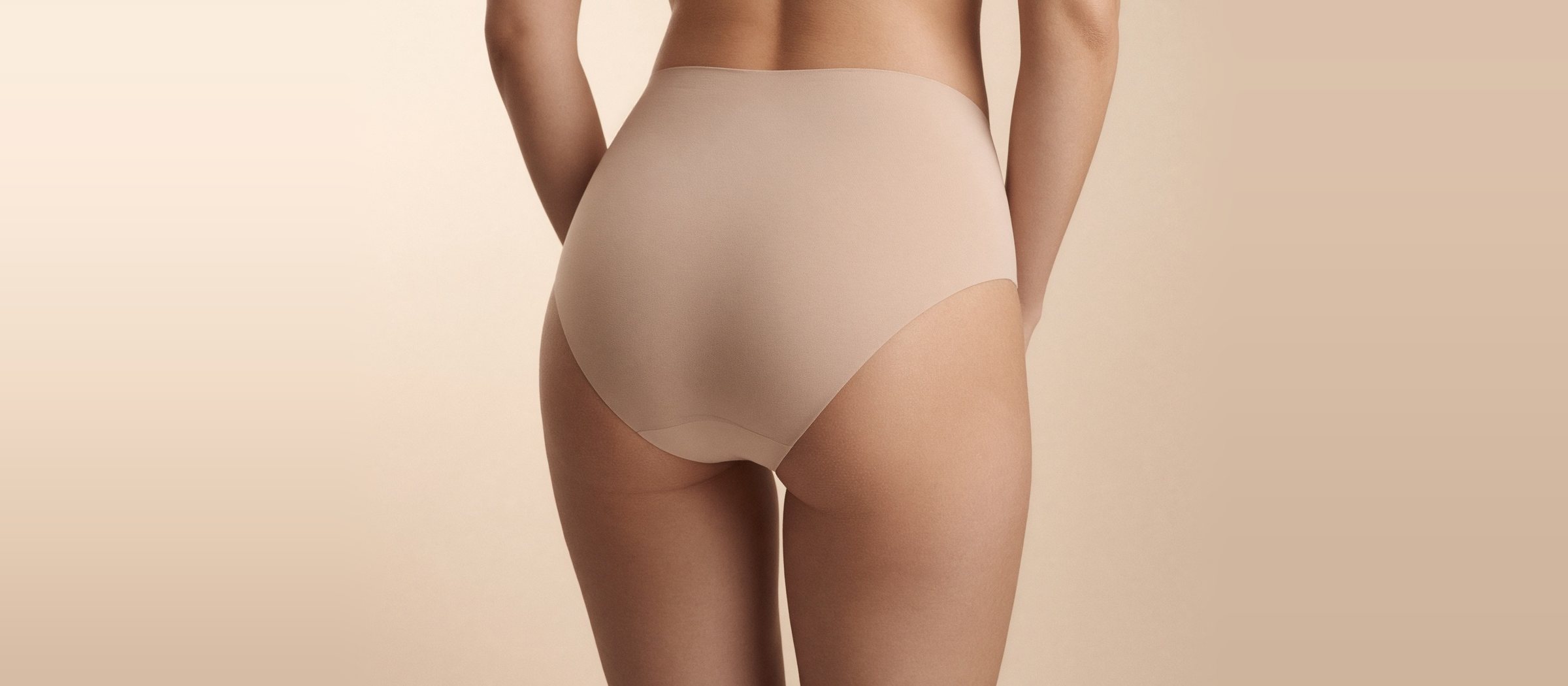
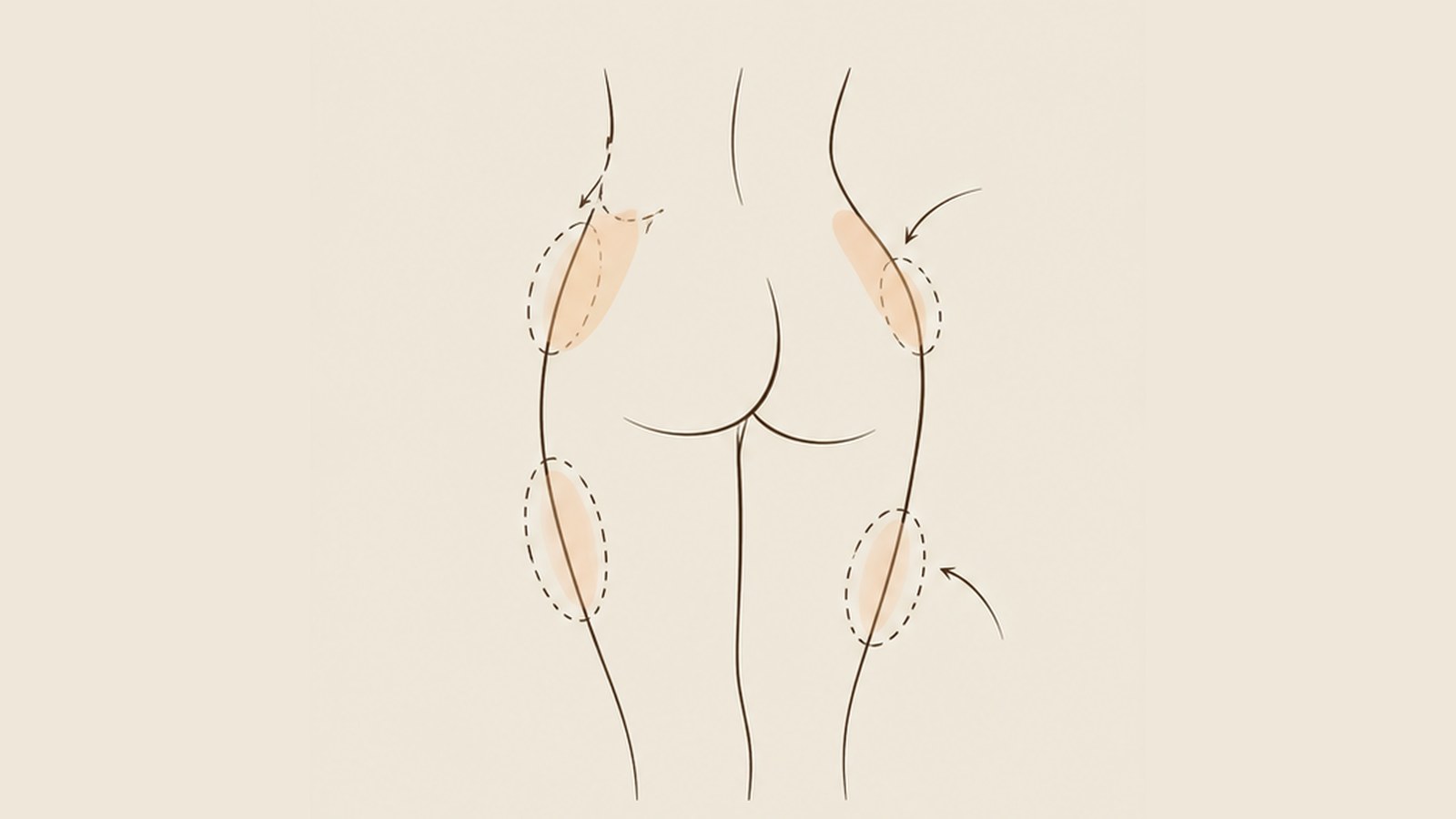
We fill the sides of the hips, the hip dips (the dip at the side, below the hip bone) and the buttocks with your own fat or with filler, so the curve from the waist to the legs flows smoothly.
LINE ONButtocks, hips & hip dips
If your hip dips haven’t changed despite glute exercises
Hip dips come largely from the shape of your bones, so exercise alone often can’t fill them.
Transfer or filler time
About 1 hour
Anesthesia
IV sedation
Where fat is taken from
Thighs, abdomen, etc.
Daily activities
From the next day
Fat retention check
After 3 months
Further transfer
3–6 months apart
Do any of these sound familiar?
If any of these apply to you, please mention it first at your consultation.
LINE ONButtocks, hips & hip dips
Point 1. Fat or filler?
Every hip dip has a different amount of space to fill
Hip dips naturally have little fat, and the space under the skin varies from person to person. The tighter the space, the harder it is for transferred fat to take. So we first check the space and the amount of fat with a physical examination and ultrasound, then decide whether to fill with fat or with filler.
LINE ONButtocks, hips & hip dips
Point 2. Purification
We transfer only pure fat
When harvested fat is spun in a centrifuge (a machine that spins quickly to separate things by weight), it separates into a layer of oil, pure fat, and blood and fluid. We transfer only the pure fat. We remove the oil layer cleanly, and keep the fat from being exposed to air while we purify it.
LINE ONButtocks, hips & hip dips
Point 3. Where fat is removed and where it’s added
We move fat from areas you’d like to slim to areas that look hollow
If there are areas you’d like to slim, such as the thighs, belly or love handles, that fat can be harvested (removed) and moved to the hips, hip dips and buttocks. So we don’t plan where to remove fat and where to add it separately. We look at your whole side profile, from the waist through the hips to the legs, and plan it all at once.
LINE ONButtocks, hips & hip dips
Areas we examine
What we look at in the hips
Hips (side profile)This sets the width of the side profile running from the waist down to the thighs. Adding volume here creates a difference in width from the waist, so a curve shows from the side.
Hip dipsThe area at the side, below the hip bone and a little above where the thigh begins, that looks like it dips inward.
Upper buttocksWhen this area is filled, the curve from the waist to the buttocks looks clearer from the side, and the buttocks look lifted. But if the skin sags a lot, filling alone may not lift it much.
Lower buttocksThe lower part of the buttocks and where they meet the back of the thighs. This area takes the most pressure when you sit.
Buttocks, hips & hip dips: the principles we follow
01We add only what the space can hold
Adding more fat doesn’t mean all of it will take. Adding more than the space can hold can actually lower fat retention (how much of the transferred fat survives and settles in).
02Left and right, balanced
The hips and buttocks are naturally a little different on each side. Before surgery, we check the difference and set the amount for each side separately.
03The width of the pelvic bones doesn’t change
Fat or filler can’t make bones wider. We refine the curve of your side profile within your natural frame.
LINE ONButtocks, hips & hip dips
How it works
From consultation to follow-up
01Consultation
For 10–15 minutes, we check the space and the fat with photos and ultrasound.
02Before surgery
We check the medications you take, your health and any past procedures.
03Method & marking
For each area, we choose between fat and filler, and mark your body while you stand.
04Anesthesia
IV sedation. If you’re having filler only, we’ll let you know after an examination.
05Harvesting
Fat is usually taken from the thighs, belly and love handles.
06Purification
The fat is centrifuged and filtered so that only pure fat remains.
07Transfer or filler
Fat or filler is added to the planned areas, which takes about 1 hour.
08SCAR OFF
The inner layer is stitched first, and the surface is stitched with as little pull as possible.
09Follow-up visit
If needed, we discuss a further transfer 3–6 months later.
Medical note
More about buttocks, hips & hip dips
From here, we explain how the surgery works, recovery and what to watch for in more detail. It’s written to the standards Dr. Oh uses when he sees patients.
Why do hip dips happen?
Hip dips aren’t a medical problem. They’re a shape that comes from your natural anatomy.
Hip dips sit between the upper ridge of the hip bone and the point where the top of the thigh bone sticks out to the side. The area between these two points sits further in, so the curve of the side profile dips inward here.
How much it dips varies from person to person, depending on the width and height of the pelvis, the position of the top of the thigh bone, the shape of the muscles at the side of the buttocks and where fat tends to collect. Strength training can change the shape around it a little, but there’s a limit to how much it can fill the dip.
The hips and buttocks are similar. If there’s little difference in width between the waist and hips, the side profile looks straight. If there’s little fat at the top of the buttocks, they look flat and saggy from behind.
How are fat transfer and filler different?
Both are ways to fill hollow areas. But they differ in how they’re prepared and how they stay in the body. Neither is always better, so we choose the one that suits the area and your body.
Fat transfer
Fat is taken from your own body, purified and then transferred. Because fat has to be harvested, it’s done under IV sedation. Part of the transferred fat is reabsorbed.
Filler
No fat is harvested; a ready-made product is injected. The amount is easy to fine-tune for each area, and it can be used even if you don’t have much fat to harvest. How long it lasts and what to watch for depend on the product, so we explain this at your examination.
Using both
Sometimes we fill the hips and buttocks with fat and the hip dips, where the space is tight, with filler. We may also fill with fat first, then add filler where more is needed.
What we check before surgery
Shape & space
While you stand, we look at your hips, hip dips and buttocks from the front, side and back, and take photos. We use ultrasound to check how much room there is in the areas to be filled.
Fat to harvest
We check the thickness of the subcutaneous fat on your thighs, belly and love handles, and estimate whether there will be enough for the transfer after purification. If not, we discuss using filler as well.
Weight plans
If you plan to lose a lot of weight after surgery, please be sure to tell us at your consultation.
Medications & medical history
Please tell us about any medications and supplements you take, any medical conditions and any past procedures. In particular, be sure to tell us if you’ve ever had filler in your buttocks or hips. We’ll tell you after your examination which tests you need before surgery and which medications to stop in advance.
Helping transferred fat stay
Not all of the transferred fat stays. Only fat that connects to blood vessels in its new place stays, and the rest is gradually reabsorbed.
Spreading it out
Fat generally settles in more easily when it’s placed a little at a time, through a thin tube, across several layers, because more of it touches the surrounding tissue. Forcing a large amount into one spot raises the risk of side effects such as oil cysts (small pockets of melted fat) or calcification (tissue hardening).
Keeping your weight
Body weight matters most for how much fat stays. After 3 months, the fat retention rate (the share of transferred fat that stays) is generally around 50%. It can drop to around 30% if you lose weight, and can rise to 70% if you gain weight.
How we perform this surgery
01
Liposuction alone, or with fat transfer?
If you only treat the thighs, only the thighs improve; if you only treat the waist, only the waist gets slimmer. If you have full buttocks, slimmer thighs alone can make your buttocks look fuller, so liposuction alone may give you the line you want. But if the hip dips, hips or buttocks themselves lack volume, liposuction alone may not be enough.
Transferred fat doesn’t slide down. Filler placed in the right spot in an appropriate amount is also unlikely to move. If too much is added, though, it can shift.
03
SCAR OFF: reducing scars where fat is harvested, too
Incisions are kept small and placed where they’re hard to see. The entry points where the cannula (a thin tube used to remove fat) goes in and out are protected with Protect, a device of our own design. We stitch the inner layer of the skin first, then stitch the surface with as little pull on the skin as possible to reduce scarring.
You’d like to fill these areas with fat from areas you want to slim
How you look in jeans or leggings matters to you
When we don’t recommend it
You’re hoping for a result beyond what your natural frame allows
You plan to lose a lot of weight after surgery
A physical examination and ultrasound show there isn’t much fat to harvest (we’ll discuss using filler instead)
Recovery
Pain
Most people feel very little pain in the buttocks. The areas where fat was harvested may ache, like sore muscles, for 1–2 weeks.
Bruising
Bruising where fat was harvested usually fades almost completely within 2 weeks.
Daily activities
From the next day.
Changes in size
Right after surgery, the treated areas look much larger because of swelling and the amount of fat added. Most of the swelling goes down in the first 2 weeks. Over the next 2 weeks, fat that didn’t take is reabsorbed. The volume goes down by about 30–40% over the first month. This is a natural process, so there’s no need to worry.
Fat retention
We check at 3 months or later. As long as you don’t lose weight, you can expect fat that has taken to stay largely as it is, just like the rest of your own fat.
Further transfer
If you’d like another transfer, we recommend waiting at least 3–6 months.
Precautions
Transferred fat is sensitive to pressure. For at least a month, avoid anything that presses on your hip dips and buttocks, such as tight clothing, sleeping on your back or sitting for long periods.
When you do have to sit, get up from time to time and change position. Your buttocks shouldn’t stay under pressure in one position for long. We’ll tell you after surgery whether you can use a cushion.
If fat was transferred to your hip dips and the sides of your hips, sleeping on your side also presses on those areas. We’ll advise you on sleeping positions based on where the fat was transferred.
Don’t firmly knead or massage the areas where fat was transferred.
We’ll tell you after surgery whether you need to wear a compression garment on the harvest sites, and for how long.
We’ll tell you when you can return to saunas, hot packs or intense lower-body exercise after checking your progress.
Please avoid alcohol and smoking for at least a month.
Eat well, sleep well and rest well so you don’t drop below the weight you had at surgery.
Results and recovery vary from person to person. Whether a treatment suits you is decided after Dr. Oh examines you in person.
Buttocks, hips & hip dips: frequently asked questions
Can I work sitting down after surgery?
For at least a month, please avoid sitting for long periods. If you spend a lot of time sitting at work, let us know at your consultation, and we’ll suggest ways to manage around your schedule.
Will both sides turn out the same?
Before surgery, we check the difference between the two sides and add different amounts, but fat may not be reabsorbed equally on both sides. If a difference still bothers you after 3 months, we’ll discuss evening out the side that needs more, at least 3–6 months later.