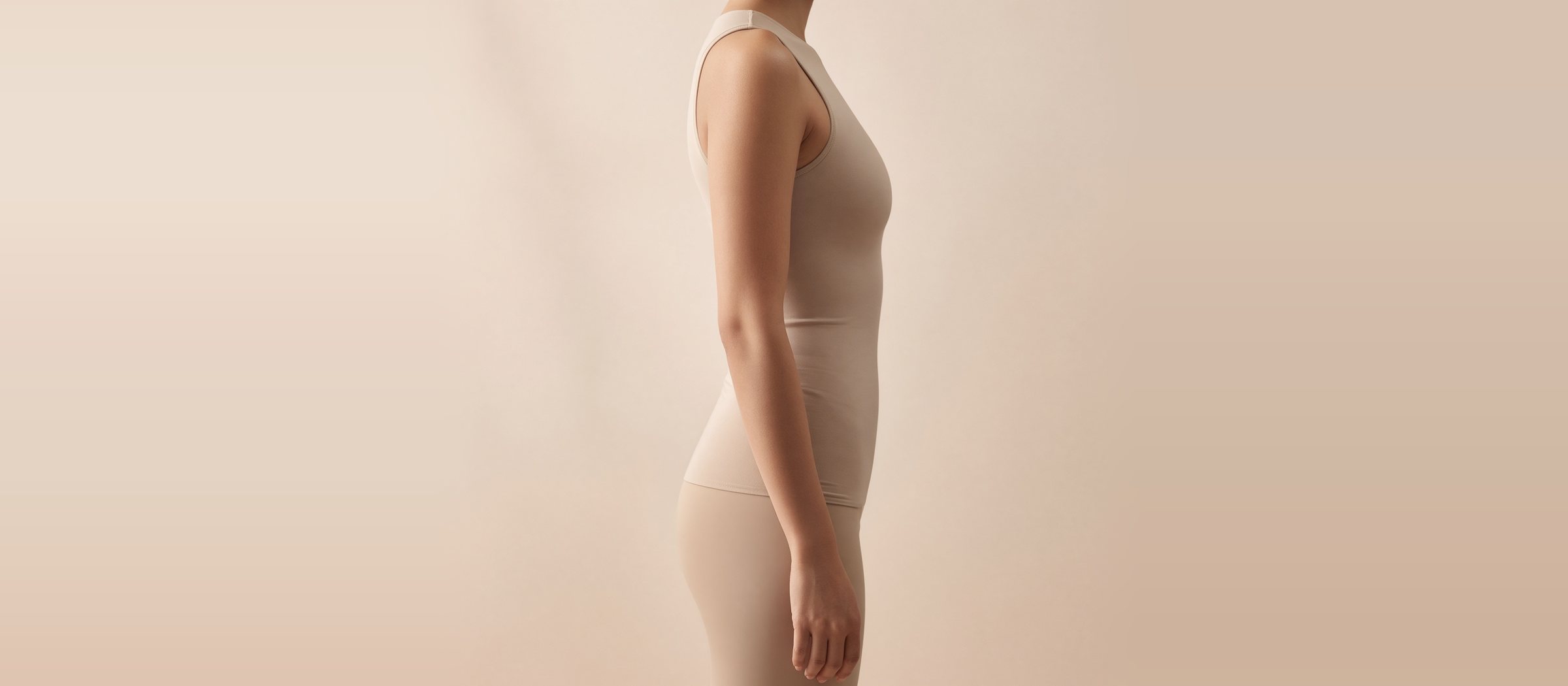
We aim for arms that taper naturally from the shoulder to the elbow and wrist.
LINE ONArm Liposuction
If you’ve lost weight but your upper arms haven’t changed
The upper arms are an area that often doesn’t slim down even when you lose weight. We remove the remaining upper-arm fat surgically.
Surgery time
Discussed after an examination
Anesthesia
IV sedation
Stitch removal
Around 2 weeks
Final contour
1–2 months
Do any of these sound familiar?
If any of these apply to you, please mention it first at your consultation.
LINE ONArm Liposuction
Point 1. Arm shape
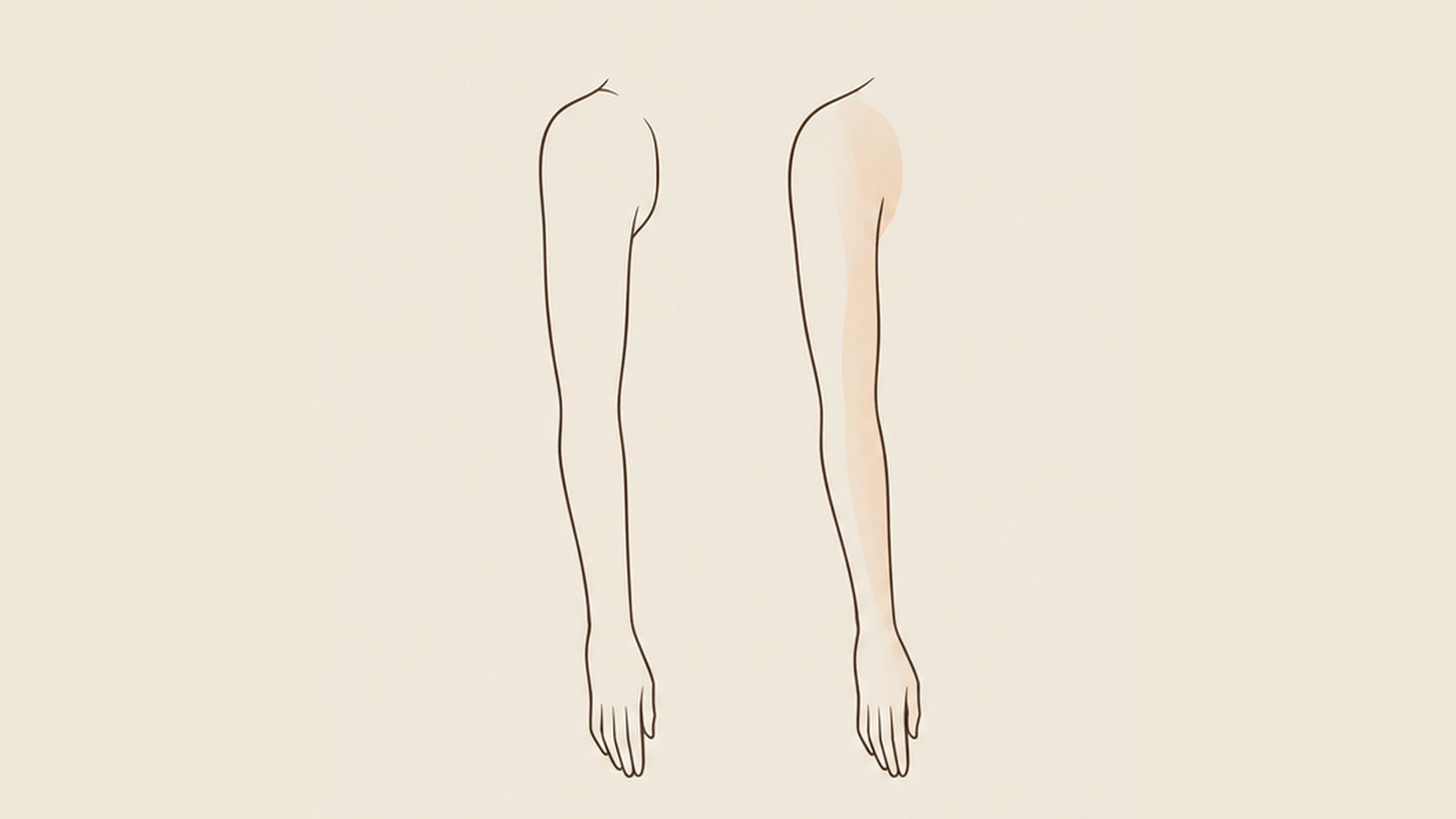
Arms look best when they taper toward the wrist
Slim arms don’t automatically look good. So we don’t look only at the arms. We also look at your shoulder width and the thickness of the front and back of the upper arm, and at the gap between your torso and arm when your arms are down.
LINE ONArm Liposuction
Point 2. Layer-by-layer liposuction
Upper-arm fat also has layers at different depths
The fat under the skin has superficial, middle and deep layers. Rather than removing as much as possible, we first decide how much to remove from which layer. Then we choose the depths that shape the contour most effectively.
LINE ONArm Liposuction
Point 3. Scars
Even small entry points are stitched to leave less of a scar
SCAR OFF is LINE ON Clinic’s way of reducing scarring. We protect the entry points where the cannula (a thin tube used to remove fat) goes in and out, and stitch the inner layer of the skin first. The surface is stitched with as little pull on the skin as possible.
LINE ONArm Liposuction
Areas we examine
What we look at in the arms
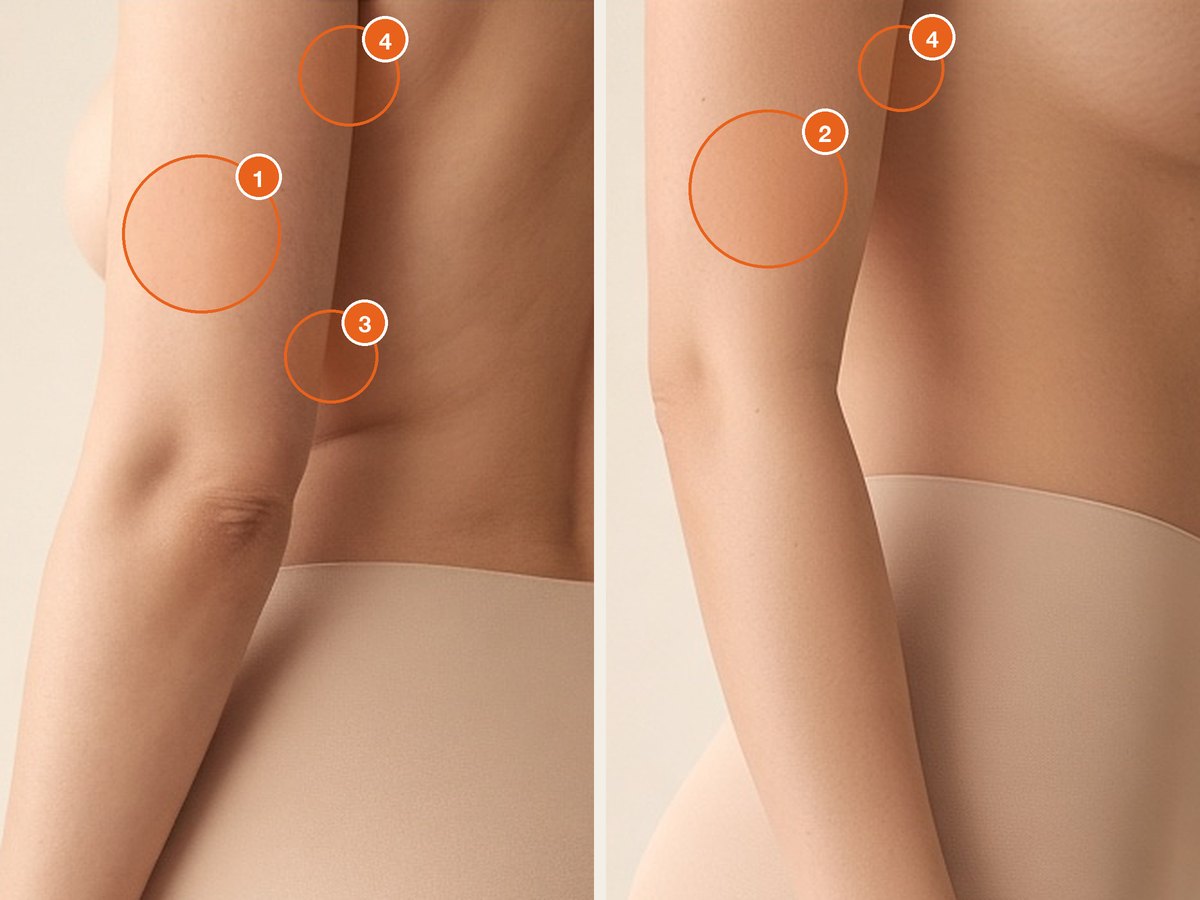
Back of the upper armThe most noticeable area when your arms are down. Changes after surgery also show clearly here.
Front & side of the upper armIf only the back is treated, the front and back can look out of balance, so we look at them together. The front usually has a thinner fat layer than the back, so we adjust how much we remove to its thickness.
Inner upper armThe area that seems to hang down when you raise your arm. The skin here tends to be thin, so we remove fat evenly to avoid lumpiness.
Front & back of the armpitWhere the arm meets the torso. The thickness here changes the gap you see when your arms are down. The front leads to the side of the chest, and the back to where the bra strap sits.
Arm Liposuction: the principles we follow
01We leave the fat that should stay
If even the fat that holds the shape is removed, the skin can stick to the tissue beneath, and the line can end up worse.
02Multiple areas are done in stages
Even if you’d like other areas done along with your arms, we split the surgery into stages so it isn’t too hard on your body.
LINE ONArm Liposuction
How it works
From consultation to follow-up
01Consultation
We listen to the shape you’d like, examine you and decide the extent.
02Pre-op tests
We do the tests needed before anesthesia.
03Marking
While you stand, we mark where fat will be removed and where it will be left.
04Anesthesia
Surgery is done while you’re asleep under IV sedation.
05Liposuction
We inject a fluid that reduces bleeding and pain, then remove the fat.
06Stitching
We stitch with the SCAR OFF method to leave less of a scar.
07Aftercare
You wear a compression garment, have your stitches removed on the scheduled day and come in for follow-up visits.
Medical note
More about arm liposuction
From here, we explain how the surgery works, recovery and what to watch for in more detail. It’s written to the standards Dr. Oh uses when he sees patients.
Why is upper-arm fat so hard to lose?
It isn’t because you haven’t tried hard enough. Fat builds up and shrinks differently in different parts of the body.
In adults, the number of fat cells generally doesn’t change much. When you lose weight, the number of cells doesn’t go down; each cell gets smaller. So areas that had many fat cells to begin with tend to stay thick even after you lose weight overall.
The back of the upper arm tends to have a thick layer of subcutaneous fat (the fat just under the skin) compared with its muscle. Liposuction reduces the number of fat cells in areas like this where thickness remains.
What we check before surgery
Two arms of the same size can respond differently, depending on whether the fullness comes from fat, loose skin or muscle. Before deciding on surgery, we check the following.
Fat thickness
We feel the four areas described above to check how much fat has built up.
Skin elasticity
We check whether your skin is likely to tighten after the fat is removed.
Health
We check the medications you take, any conditions you have and any past surgery.
How is it different from injections or exercise?
The right approach differs from person to person. We decide after an examination, based on how much fat there is, how much change you’d like and how much time you can set aside for recovery.
Exercise & diet
These reduce fat across the whole body and firm the muscles. But it’s hard to target fat in one area, such as the back of the upper arm.
LINE ON Injection
A non-surgical injection treatment that reduces fat cells and eases puffiness (fluid built up in the body). You can return to daily activities the same day. But there’s a limit to how much one session can reduce, so at most it refines a contour. We recommend 3 sessions, 1 month apart.
Liposuction
Because it removes fat cells directly, one session can reduce more than injections. In return, it needs recovery time and leaves small scars at the entry points.
Where will the scars be?
Liposuction needs entry points for the tube that removes fat. So the marks at the entry points can’t be avoided entirely. Instead, we keep the entry points small and choose places hidden by clothing or skin creases.
For the arms, the entry points are usually in the armpit crease or near the elbow. They sit in a crease or are hidden when your arms are down.
Scars usually look red or dark for the first few months, then gradually fade. How much they fade depends on your skin type. At your examination, we mark your body as we explain where the entry points will go and how many there will be.
How we perform this surgery
01
We set the target size to suit your shoulder width
If you have broad shoulders and a fuller upper body and aim only for very slim arms, your arms may get slimmer but your shoulders can look broader. So we look at your shoulder width and shape and your upper body before deciding how slim to make your arms.
Who this surgery suits, and who it doesn’t
Your weight is fairly stable, but your upper arms and the area around your armpits are thick
Your skin still has reasonable elasticity (elasticity affects the result)
When we don’t recommend it
You’re already very slim and want to lose more (removing more can actually spoil the line)
Your skin is very loose (liposuction alone has limits, so we’ll discuss this after an examination)
You’re pregnant or breastfeeding, you take medication that affects blood clotting, or you have an uncontrolled medical condition (whether and when surgery is possible is decided after an examination)
Recovery
Bruising
Usually almost gone within 2 weeks.
Swelling
Most swelling goes down in about 1 month, and the rest in about 3 months.
Recovery for the arms
The arms are a small area and less fat is removed, so recovery tends to be quick. The shape may be mostly visible by around 2 weeks, when the stitches come out, and the final contour may show at 1–2 months.
Precautions
Wearing a compression garment alone won’t improve your result. While wearing it, stretch the treated area and exercise moderately to give the skin steady stimulation that helps its elasticity.
Alcohol and smoking slow recovery. Please avoid them for the period we advise.
If you don’t exercise enough and keep overeating after surgery, the results can fade. Please keep up exercise and a healthy diet.
Please wear your compression garment for the period we advise. If it bunches up and presses on one side or feels too tight, tell us right away.
Don’t stay lying down after surgery. Take short, easy walks often, without overdoing it. Better circulation helps swelling go down.
Salty and spicy foods can increase swelling. Cut back on them while you recover, and drink plenty of water.
Please wait until we’ve checked your progress before firmly massaging or rubbing the treated area. The same goes for saunas and hot baths.
Contact us right away, without waiting, if you have a fever, if one side is unusually swollen and painful, or if pus or blood keeps coming from an incision.
For the first few days, keep your arms slightly above heart level when resting. Less swelling will drain down toward your hands.
Start lifting heavy things or doing exercise that uses your arms a lot gradually, after we’ve checked your progress.
Results and recovery vary from person to person. Whether a treatment suits you is decided after Dr. Oh examines you in person.
Arm Liposuction: frequently asked questions
If only the upper arms are treated, won’t my forearms look bigger?
Usually, more fat collects in the upper arm, so refining the upper arm often makes it flow more naturally into the forearm. It does depend on your shoulder width, the thickness around your elbow and the size of your forearm. We look at the proportions from your shoulder to your wrist and discuss how far to go after an examination.
Will the skin on my arms sag after the fat is removed?
When fat is removed, the skin tightens to some degree along with it. How much it tightens varies with your age, your skin’s natural elasticity and the amount removed.
Could it end up lumpy or dented?
The arms have fairly thin skin and fat layers. If too much fat is removed from one spot, or fat is removed too close to the surface, the area can become lumpy. For a few weeks during recovery, it may feel firm or uneven, but this usually softens over time. If lumpy areas remain after that, we’ll discuss ways to improve them after an examination.
Will the swelling and bruising move down to my hands?
In the first few days after surgery, swelling and bruising can move downward and show below the elbow or on the back of the hand. This happens because of gravity.
When can I return to daily activities and exercise?
We’ll tell you the exact timing based on the area treated and how you’re recovering. Light everyday movement is often possible fairly early.
Can accessory breast tissue be treated at the same time?
The front of the armpit is where the arm meets the torso, so it’s often assessed together with the arm. But accessory breast tissue (breast tissue that bulges toward the armpit) can contain glandular tissue as well as fat. Glandular tissue doesn’t reduce well with liposuction. We’ll explain what kind of tissue it is, and whether treating it at the same time makes sense, after an examination.
Can the fat come back after arm liposuction?
Liposuction reduces the number of fat cells in the treated area. But the remaining fat cells can grow again, so if you gain weight, fat can build up again in the treated area too.