01
We remove fat first, the LINE ON way
Liposuction comes first. We leave the superficial layer and decide how much to remove from the middle and deep layers. Then we use Renuvion where the skin needs to shrink back.
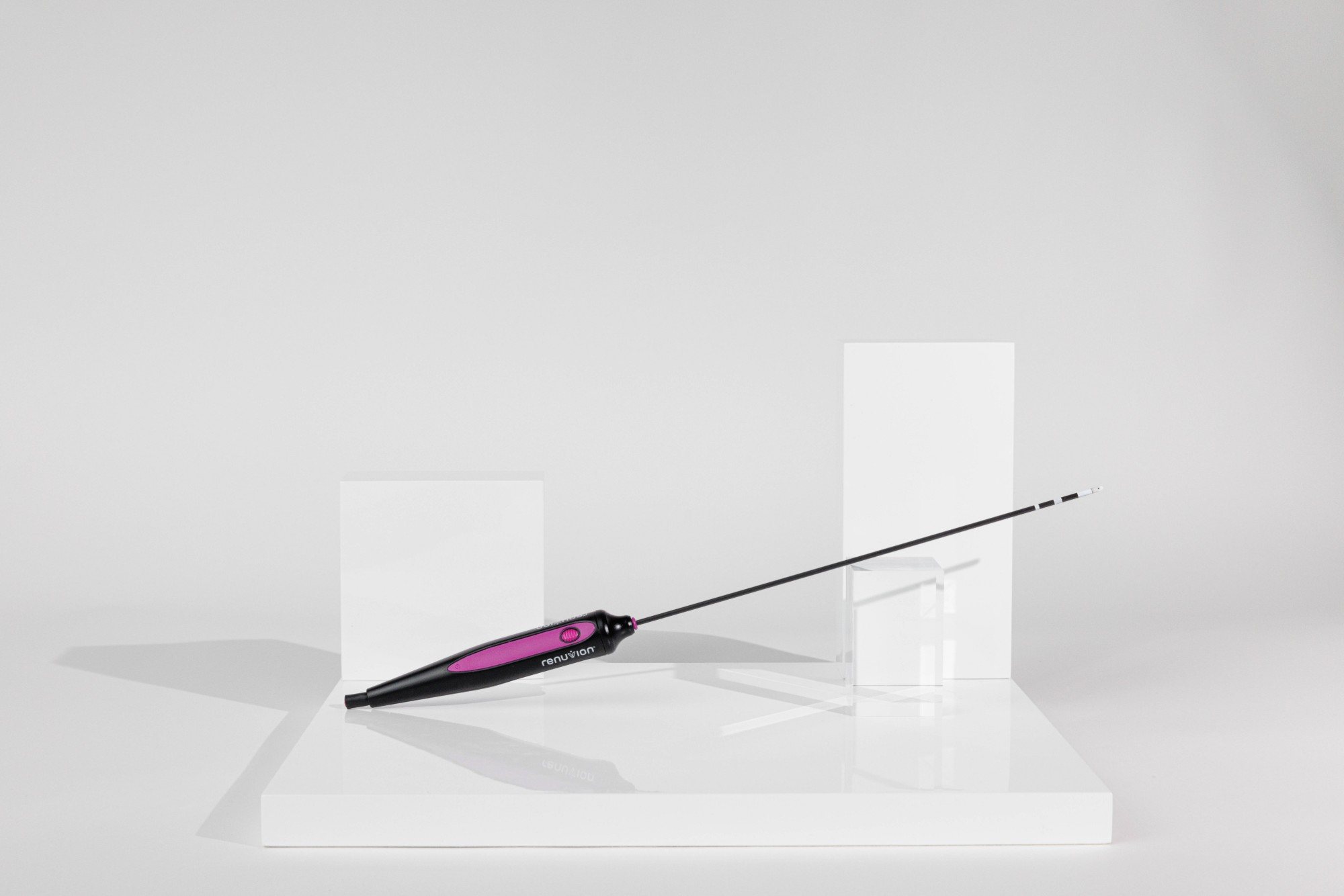
Renuvion
A treatment that uses helium plasma to briefly heat the fibrous tissue under the skin so it contracts. It’s used to tighten skin that tends to loosen after liposuction, and sagging along the neck and jawline.
LINE ONRenuvion
When fat is removed, the skin over it needs to shrink back by the same amount to look smooth. Renuvion is a device that helps the skin shrink back, working from under the skin.
If any of these apply to you, please mention it first at your consultation.
LINE ONRenuvion
Point 1. Under the skin
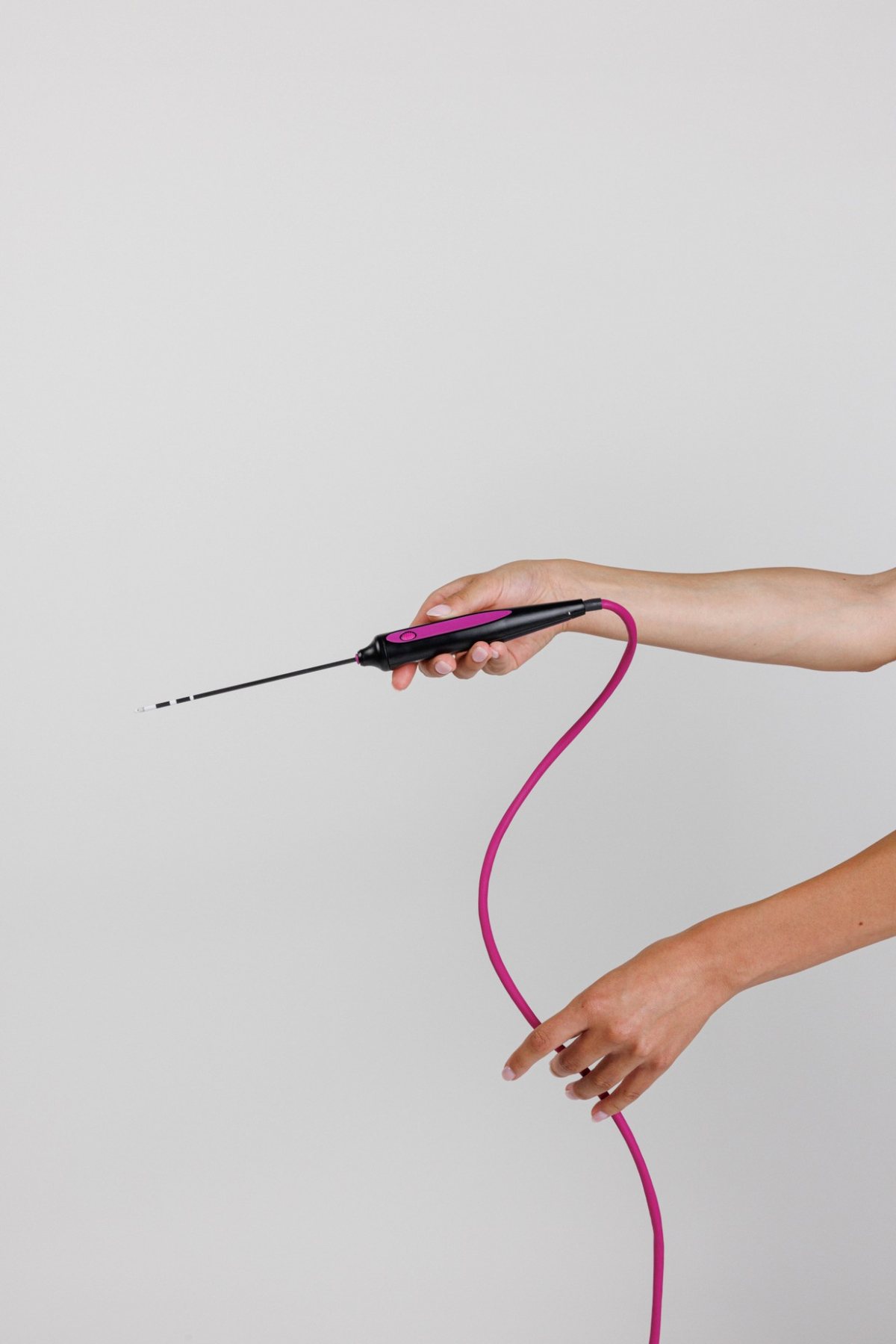
Under the skin, a mesh of fibrous tissue (fibrous septa) connects the skin to the fascia beneath. When this tissue loosens, the skin sags. With Renuvion, a thin, rod-shaped instrument (the handpiece) is placed in the same layer as liposuction to heat this fibrous tissue directly. As the heated tissue shrinks, it pulls the skin back in. Unlike devices that send heat in from the skin surface, the heat goes straight to where it’s needed.
LINE ONRenuvion
Point 2. 85°C, 0.04 seconds
Radiofrequency and laser devices that heat from the skin surface need to keep the tissue under the skin at 45–65°C for more than 2 minutes for collagen to contract. Renuvion passes radiofrequency energy through helium gas to create plasma, which heats the fibrous tissue to about 85°C in an instant. At this temperature, collagen shrinks in 0.04 seconds. Because the heat doesn’t stay in one spot for long, the skin surface doesn’t go above 41°C.
LINE ONRenuvion
Point 3. Same entry points
Once liposuction is finished, the Renuvion handpiece goes in through the same entry points. No new incisions are made, and it takes about 15 minutes longer per area. If only loose skin is treated, without liposuction, one small entry point is all it needs.
We first use an examination and ultrasound to see whether the sagging comes from fat or from loose skin. If there’s enough excess skin to fold, surgery with incisions may suit you better. If so, we’ll tell you.
Not every liposuction needs Renuvion. We recommend it when a lot of fat is being removed, or for areas where the skin is naturally thin and tends to loosen (the arms, abdomen, inner thighs and under the chin).
The tissue starts to shrink right after treatment. But it takes 6–9 months for new collagen to form and for the shape to settle. During that time, we check your progress at 1, 2 and 3 months.
LINE ONRenuvion
How it works
We use ultrasound to check fat thickness, and gently pinch the skin to see how loose it is.
We decide whether to combine it with liposuction or do Renuvion alone, and which areas to treat.
Depending on the extent, it’s done under IV sedation or local anesthesia.
After liposuction, Renuvion is done through the same entry points. It adds about 15 minutes per area.
You wear a compression garment, and we check your progress at 1, 2 and 3 months.
Medical note
Renuvion in detail
From here, we explain how the surgery works, recovery and what to watch for in more detail. It’s written to the standards Dr. Oh uses when he sees patients.
It’s a helium plasma device made by Apyx Medical in the US. Helium gas flows over an electrode carrying radiofrequency energy, which creates plasma. The heat this produces coagulates the tissue under the skin and makes it shrink.
It has FDA 510(k) clearance in the US. It was cleared for coagulating and contracting the tissue under the skin, and for body contouring after liposuction. In July 2022, an indication was added for improving the appearance of loose skin in the neck and under the chin.
In Korea, it was approved by Korea’s MFDS in 2025. The Renuvion handpiece and the Apyx One system it connects to are both available in Korea.
Skin-tightening devices differ in where they deliver heat, how hot, and for how long.
Studies are ongoing in the neck and under the chin, on the body after liposuction, on the forehead and elsewhere. Here are just the key findings.
01
Liposuction comes first. We leave the superficial layer and decide how much to remove from the middle and deep layers. Then we use Renuvion where the skin needs to shrink back.
02
In each area, we move the handpiece evenly within a set range. If heat builds up in one spot, recovery can take longer and the skin can be damaged, so we don’t pass over the same spot again and again.
03
After treatment, you wear a compression garment so the tightened tissue settles back in place. We check your progress at 1, 2 and 3 months.
When we don’t recommend it
Results and recovery vary from person to person. Whether a treatment suits you is decided after Dr. Oh examines you in person.
It’s a treatment that uses helium plasma to heat the fibrous tissue under the skin to about 85°C in an instant, so it shrinks. It’s used for skin that tends to loosen after liposuction and for a sagging neck and under-chin area.
Liposuction removes fat, but it doesn’t shrink the skin over it. Where a lot of fat is removed or the skin is thin, the skin may not shrink back enough and can sag. Using Renuvion in those areas can help the tissue under the skin shrink. If your skin is firm, liposuction alone is often enough.
Yes. It has FDA 510(k) clearance in the US. The cleared uses are improving the appearance of loose skin in the neck and under the chin, contracting the tissue under the skin, and body contouring after liposuction. It’s also a medical device approved by Korea’s MFDS.
Depending on the extent, we use IV sedation or local anesthesia, so it shouldn’t hurt much during treatment. In the neck and under-the-chin study, 96.9% had no pain or pain no worse than moderate for 7 days after treatment.
It adds about 15 minutes per area to the liposuction time. The total time depends on how many areas are treated and the extent.
The tissue starts to shrink right after treatment, but it takes 6–9 months, while new collagen forms, for the shape to settle. How long the results last varies from person to person, depending on skin condition, age and changes in weight.
When it’s combined with liposuction, we use the same entry points. Even with Renuvion alone, one small entry point for the handpiece is enough. The entry points are protected and stitched with the SCAR OFF method.
It ranges from a few days to a few weeks, depending on the area and extent. If it was done with liposuction, recovery is much like liposuction recovery: bruising usually lasts about 2 weeks, and heavy swelling about a month.
Swelling, bruising and a firm feeling for a while are common. Rarely, there may be numbness or muscle weakness, a collection of blood or fluid (hematoma or seroma), or burns or blisters. In a study of 483 patients who had Renuvion after liposuction, the risks were no higher than with liposuction alone.
Ultrasound and radiofrequency lifting send energy in from the skin surface, so there’s almost no recovery time. But the change tends to be mild, so people often have several sessions. Renuvion goes under the skin and heats the fibrous tissue directly. There is recovery time, but it’s used when the skin is more noticeably loose and after liposuction.
Yes. When weight comes off quickly, the skin may not shrink back enough and can sag. Once your weight has fairly stabilized, we examine both the remaining fat and the loose skin and plan from there.
An animal study (2023) found that when the recipient site was heated with Renuvion first, more of the transferred fat survived. However, this hasn’t been confirmed in people. So at LINE ON Clinic, we don’t recommend Renuvion as a way to help more of the fat stay.
We are a 30-second walk from Gangnam Station Exit 3, and the medical director examines every patient in person.