01
Filler alone can spread
When skin is stretched, it tends to pull back (elastic recoil). So if the shape is created with filler alone, it can spread over time.

Thread lift
A treatment that supports sagging areas with dissolvable threads.
LINE ONThread Lift
Why a face looks saggy differs from person to person. So before placing any threads, we first look at why it looks that way.

If any of these apply to you, please mention it first at your consultation.
LINE ONThread Lift
Point 1. Sagging and hollowing
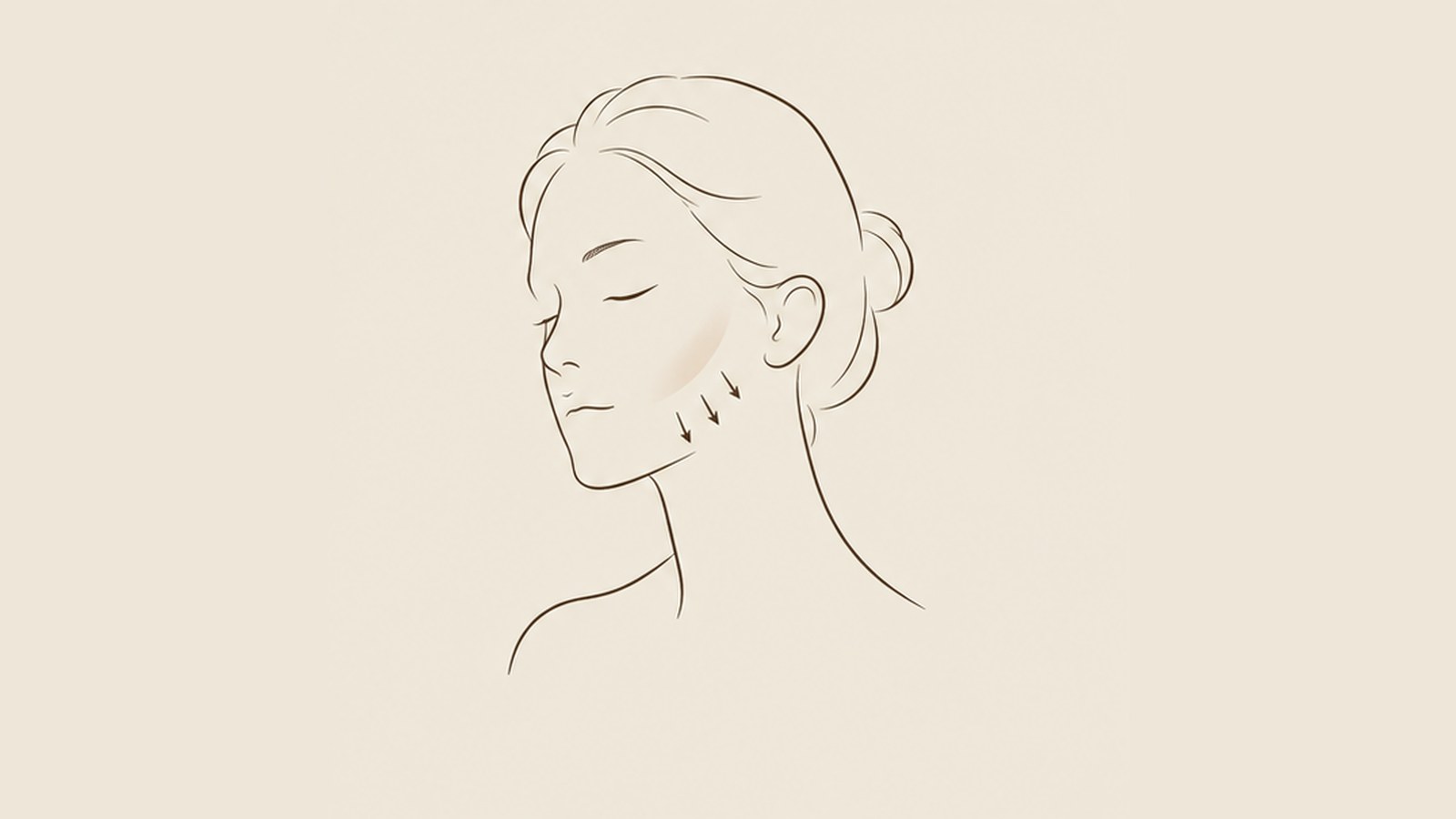
A face that looks older has a mix of loosened areas and hollow areas. Loosened areas can be supported with threads. But areas that are hollow because supporting tissue has weakened may be better filled, so we tell the two apart first.
LINE ONThread Lift
Point 2. Threads and filler
Threads behave more like a solid, and filler more like a gel that flows. It’s similar to putting up a building: steel rebar forms the frame and concrete gives it shape. If needed, we support with threads and add only fine volume with filler.
LINE ONThread Lift
Point 3. Thread protrusion
Skin naturally tends to pull back to where it was. As the end of a thread keeps resisting this pull, the thread can sometimes be felt or come out through the skin. Knowing this, we plan to reduce the chance of that happening.
LINE ONThread Lift
Areas we examine
Face shape, how much the skin has loosened and skin thickness all differ from person to person. After your examination, we’ll tell you which threads to use, where and how many.
If there’s a lot of loose skin, or the main issue is lost volume, threads alone have limits. In that case, we’ll also tell you about other options, including surgery.
If a thread can be felt or has poked through, we can remove the thread from that area if you wish.
LINE ONThread Lift
How it works
We check whether it’s loosening or hollowing.
We check for medications that make bleeding harder to stop, and your past treatments.
With you sitting up, we mark the direction each thread will go.
We’ll explain the anesthesia options after your examination.
We place the threads along the marked directions and balance both sides.
We trim the thread ends and schedule your follow-up visits.
Medical note
Thread Lift in detail
From here, we explain how the surgery works, recovery and what to watch for in more detail. It’s written to the standards Dr. Oh uses when he sees patients.
With age, facial bone is gradually resorbed and shrinks, and the deep layer of fat under the skin also decreases. As the skin loses elasticity, the shallow layer of fat sags, and the muscles weaken and stretch. That’s why a face that was an inverted triangle in youth gradually becomes closer to a triangle.
Absorbable sutures (threads) are placed under the skin in planned directions to support loosened tissue. The threads go in through a needle or a thin tube, so no large incision is needed.
Threads come in two main types. Threads with small barbs on the surface catch the tissue and are used to lift areas that have loosened. Smooth threads without barbs are mainly used for skin texture and elasticity.
Both are made of absorbable material that dissolves gradually in the body over time.
Most of the following changes are temporary, but how much and for how long varies from person to person.
01
When skin is stretched, it tends to pull back (elastic recoil). So if the shape is created with filler alone, it can spread over time.
When we don’t recommend it
Results and recovery vary from person to person. Whether a treatment suits you is decided after Dr. Oh examines you in person.
Threads dissolve over time, and the support they give gradually decreases. How long the effect lasts varies from person to person, depending on the type of thread, skin thickness and how much the skin has loosened. We’ll explain after your examination.
Small dot-like marks form where the threads went in. They usually fade over time, but how much depends on your skin.
Most people can go about their day without much difficulty. Generally, though, swelling and tightness can last a few days, and bruising 1–2 weeks. If you have an important event coming up, please tell us at your consultation.
Many people have another thread lift once the threads have dissolved and the effect has faded. When you do, we look at the type and timing of your previous threads and how much sagging there is now, and plan only what’s needed.
Absorbable threads dissolve over time. Still, if you have surgery, please tell your surgeon when you had your thread lift and what type of threads were used.
We are a 3-minute walk from Gangnam Station Exit 11, and the medical director examines every patient in person.