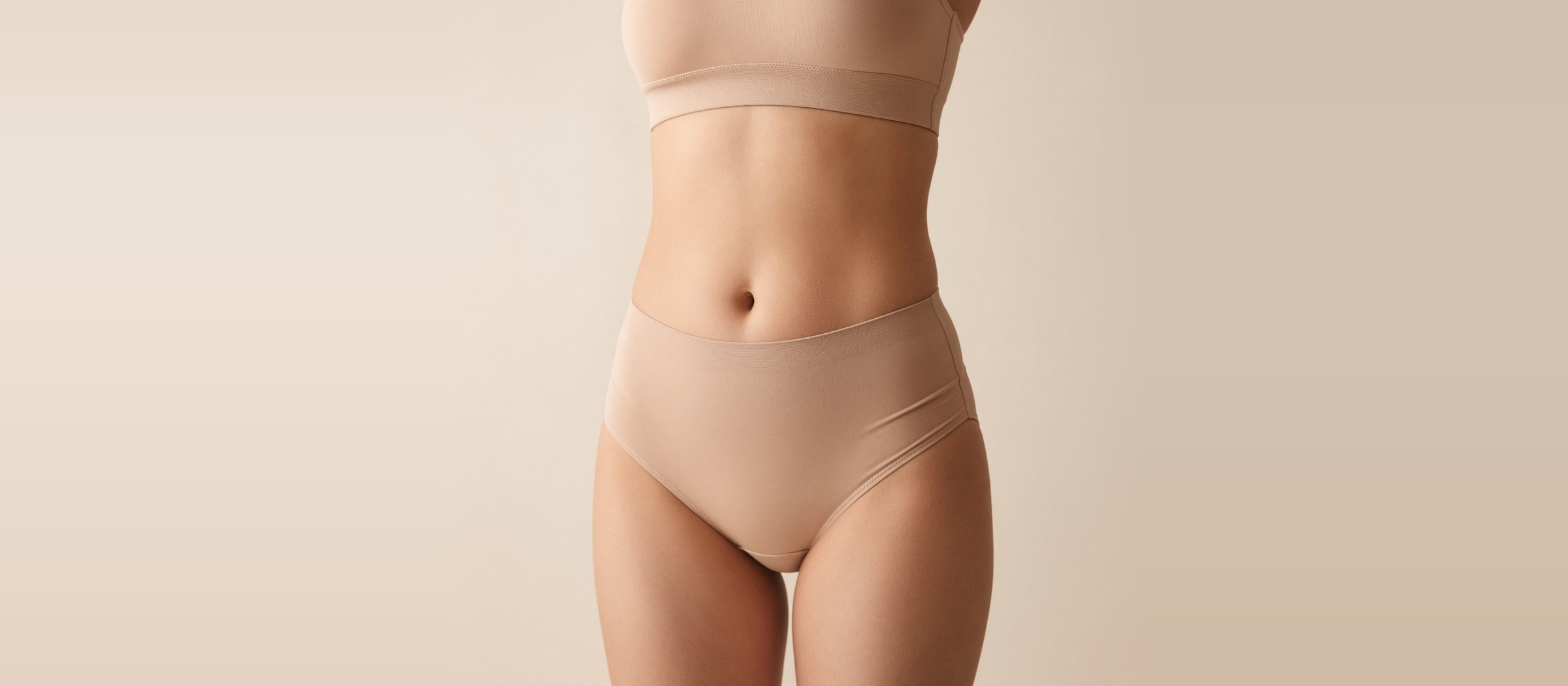
When we look at the abdomen, we also look at the shape of the torso from below the ribs to the waist and hips.
LINE ONAbdominal Liposuction
If you’re tired of hiding a belly that folds every time you sit
A flatter belly alone may not make your body look slimmer.
Surgery time
Discussed after an examination
Anesthesia
Discussed after an examination
Stitch removal
Discussed after an examination
Final contour
Usually 3 months
Do any of these sound familiar?
If any of these apply to you, please mention it first at your consultation.
LINE ONAbdominal Liposuction
Point 1. Torso shape
We look not only from the front but from the side too
Rib cage size and pelvic width differ from person to person, so we can’t aim for the same belly for everyone. From the front, we look at the proportions of your waist and hips. From the side, we look at how far your belly and waist curve in. Then we set natural proportions within your natural frame.
LINE ONAbdominal Liposuction
Point 2. Subcutaneous fat & layers
Not all belly fat is the same kind of fat
The abdomen has subcutaneous fat, just under the skin, and visceral fat, which sits around the organs beneath the abdominal muscles. Liposuction can only remove subcutaneous fat, so before surgery we first check which type is causing your belly to stick out. We remove subcutaneous fat layer by layer, at the most effective depths.
LINE ONAbdominal Liposuction
Point 3. Recovery time
We judge the final shape at around 3 months
How much fat is removed from the abdomen differs from person to person, so the time it takes for bruising and swelling to fully go down differs too. If you’re worried in the meantime, we’ll check your progress with you.
LINE ONAbdominal Liposuction
Areas we examine
What we look at in the abdomen
Upper abdomenFrom below the breastbone to above the navel. This is where the belly folds when you sit. The fat layer is often thinner here than in the lower abdomen, so we check its thickness as we go.
Lower abdomenFrom below the navel to the front of the hip bones. Fat here often stays even after weight loss.
Edge of the flanksWhere the abdomen turns into the sides. The belly you see from the front and the waist you see from the side meet here.
Abdominal Liposuction: the principles we follow
01We leave enough fat for the belly to look smooth
Removing a lot of fat, even from the superficial layer, to show the abdominal muscles can leave the belly lumpy. So we first decide how much thickness to leave.
02We plan the abdomen and flanks together
The abdomen and flanks are part of one continuous torso, so we often plan them together to avoid an awkward transition.
LINE ONAbdominal Liposuction
How it works
From consultation to follow-up
01Consultation
We listen to the shape you’d like, examine you and decide the extent.
02Pre-op tests
We do the tests needed before anesthesia.
03Marking
While you stand, we mark where fat will be removed and where it will be left.
04Anesthesia
We’ll let you know the type of anesthesia after an examination.
05Liposuction
We inject a fluid that reduces bleeding and pain, then remove the fat.
06Stitching
We stitch with the SCAR OFF method to leave less of a scar.
07Aftercare
You wear a compression garment, have your stitches removed on the scheduled day and come in for follow-up visits.
Medical note
More about abdominal liposuction
From here, we explain how the surgery works, recovery and what to watch for in more detail. It’s written to the standards Dr. Oh uses when he sees patients.
Why is belly fat so hard to lose?
The abdomen is an area where fat builds up easily.
Subcutaneous fat also has superficial and deep layers. The lower abdomen in particular is known to be an area where the deep layer thickens easily. This is one reason the lower belly can remain even after weight loss.
Pregnancy, childbirth or a large change in weight affects not only fat but also the skin and muscles. So for the abdomen, we need to look at the skin and muscles as well before we can plan.
What we check before surgery
How much fat is removed, and your overall condition, vary widely from person to person. Before deciding on surgery, we check the following.
Fat proportion
We check how much subcutaneous fat you can pinch. If you have a lot of visceral fat, liposuction alone may not reduce your waist size much.
Skin elasticity
We check whether your skin is likely to tighten after the fat is removed. If the skin is very loose, it can look wrinkled after liposuction. If so, we’ll tell you in advance.
Abdominal muscles & navel
If your abdominal muscles have separated after childbirth, or you have a hernia near the navel (where the intestine pushes through a gap in the muscle), liposuction won’t fix it. The surgical plan will also be different.
Past surgery
If you’ve had abdominal surgery, such as a C-section or laparoscopic surgery, the tissue there may be firmly stuck together. So we check this in advance.
Health
We check the medications you take, any conditions you have and any past surgery.
Where will the scars be?
Liposuction needs entry points for the tube that removes fat. So the marks at the entry points can’t be avoided entirely. Instead, we keep the entry points small and choose places hidden by clothing or skin creases.
For the abdomen, the entry points are usually inside the navel or below the underwear line, where they’re hidden by clothing and skin creases. If the flanks are treated too, an entry point may also be placed near the underwear line at the lower back.
Scars usually look red or dark for the first few months, then gradually fade. How much they fade depends on your skin type. At your examination, we mark your body as we explain where the entry points will go and how many there will be.
How we perform this surgery
01
SCAR OFF: stitching to reduce scarring
The entry points where the cannula (a thin tube used to remove fat) goes in and out are protected with Protect, a device of our own design. We stitch the inner layer of the skin first, and stitch the surface with as little pull on the skin as possible.
Your weight is fairly stable, but subcutaneous fat has collected on your abdomen and flanks
Your skin still has reasonable elasticity
When we don’t recommend it
You’re already very slim and want to lose more (removing more can actually spoil the line)
An examination shows there isn’t much fat that can be removed
You’re hoping for a result beyond what your natural frame allows
Your belly sticks out mainly because of visceral fat
Your skin is very loose, or your abdominal muscles have separated significantly
You’re pregnant or breastfeeding, you take medication that affects blood clotting, or you have an uncontrolled medical condition (whether and when surgery is possible is decided after an examination)
Recovery
Bruising
Usually almost gone within 2 weeks.
Swelling
Most swelling goes down in about 1 month, and the rest in about 3 months. If a lot of fat was removed or there was more tissue trauma, it can take 3–6 months. Even so, the shape usually doesn’t look very wrong in the meantime.
Recovery for the abdomen
The final contour usually shows after about 3 months. Even so, after just 1 month, the area is much slimmer than before surgery.
Precautions
Wearing a compression garment alone won’t improve your result. While wearing it, stretch the treated area and exercise moderately to give the skin steady stimulation that helps its elasticity.
Alcohol and smoking slow recovery. Please avoid them for the period we advise.
If you don’t exercise enough and keep overeating after surgery, the results can fade. Please keep up exercise and a healthy diet.
Please wear your compression garment for the period we advise. If it bunches up and presses on one side or feels too tight, tell us right away.
Don’t stay lying down after surgery. Take short, easy walks often, without overdoing it. Better circulation helps swelling go down.
Salty and spicy foods can increase swelling. Cut back on them while you recover, and drink plenty of water.
Please wait until we’ve checked your progress before firmly massaging or rubbing the treated area. The same goes for saunas and hot baths.
Contact us right away, without waiting, if you have a fever, if one side is unusually swollen and painful, or if pus or blood keeps coming from an incision.
For the first few days, getting up can pull on your abdomen as your stomach muscles tense. It’s much easier if you roll onto your side first and push up with your arms.
Results and recovery vary from person to person. Whether a treatment suits you is decided after Dr. Oh examines you in person.
Abdominal Liposuction: frequently asked questions
Does it also reduce visceral fat inside the abdomen?
No. Liposuction removes subcutaneous fat, the fat under the skin. It doesn’t reach visceral fat, which sits beneath the abdominal muscles and around the organs. Visceral fat has to be managed through diet, exercise and lifestyle.
Will it help a belly that stretched after childbirth?
It can reduce thickness caused by fat. But liposuction doesn’t change loose skin or separated abdominal muscles. So we first examine your skin and muscles, then tell you whether liposuction is the right option.
Will my abs show?
When the fat layer gets thinner, the outline of the muscles you already have may show more than before. But liposuction doesn’t create abs. If you want a firm stomach, you need to exercise after surgery.
Can the abdomen, flanks and thighs all be done at once?
There’s no fixed upper limit on how much can be removed in one session. It depends on your body weight, how much tumescent solution (fluid injected before liposuction) is used, and how much bleeding there is during liposuction. But liposuction is surgery that carries real risks, so we don’t treat the whole body in one session. If you’d like several areas treated, we split them into at least two sessions.
My belly feels hard and lumpy after surgery. Is that normal?
For a few weeks after surgery, the treated area commonly feels hard, lumpy or tight, and it may feel numb. This often happens as the skin and the tissue beneath it reattach and heal where the fat was removed. It usually softens over a few months. It varies from person to person, so if one area is unusually swollen and painful, or you have a fever, please let us know right away.
How long do I need to wear a compression garment?
We’ll tell you how long based on the area treated and how you’re recovering. A compression garment helps reduce swelling and helps the skin settle evenly.
Can belly fat be reduced with injections instead?
LINE ON Injection can also refine a contour by reducing fat cells and easing puffiness. But there’s a limit to how much one session can reduce, so at most it refines a contour. We recommend 3 sessions, 1 month apart. If there’s a thick layer of fat, liposuction is often the better fit. We’ll tell you which suits you after an examination.